


The amount of money that both individual users and businesses pay for AI services is going to increase dramatically over the next six to eighteen months. The only variables, as far as I can see, are how much more we will pay, and how quickly it will happen.
There are three reasons for this:
Demand is rapidly outstripping supply
Infrastructure cannot possibly keep pace
AI is now a utility, not a luxury
I’ll delve into each of these factors below, but it’s worth noting that we can already see signs of this happening. Anthropic has already begun tightening usage limits for its hugely popular Claude service and most of the free AI options have inexorably shrunk the number of prompts allowed per day. We may see ad-supported options soon, but paying with your personal data is still paying.
Demand growth is geometric
Any usage graph you care to look at shows that demand for AI services is increasing geometrically – in other words the rate at which it’s increasing is itself growing more every day. This produces the classic exponential graphs that we all came to love during COVID.
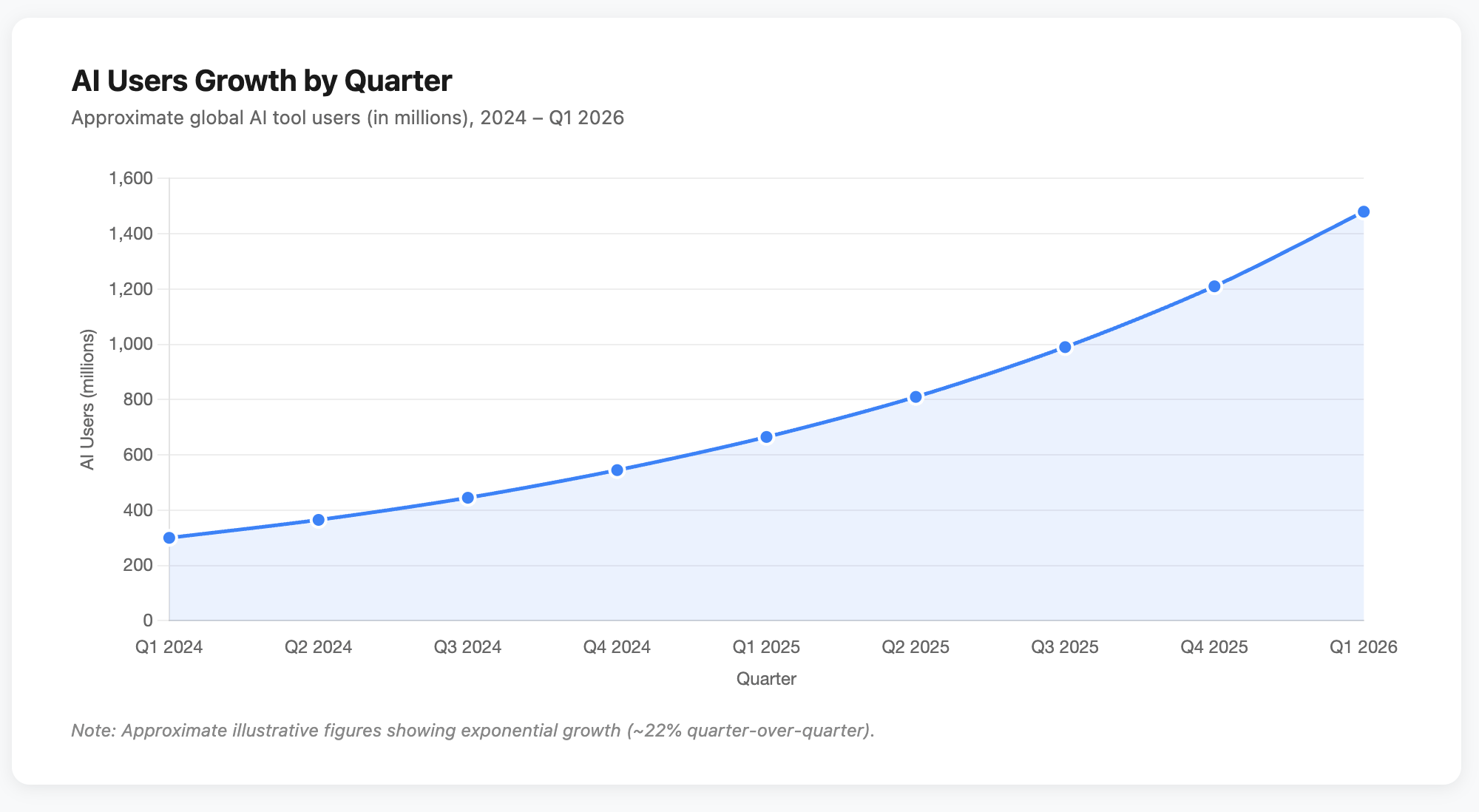
An important detail here is that it’s not just human users that are driving this demand. In fact, we are likely to be a relatively small proportion of total usage. Very large businesses have already integrated AI into time-intensive back-office processes. This can result in a single large company sending millions of prompts to an AI provider every week (or even every day). Most of these prompts are far more focussed and parsimonious than a query by a human, but there are so many more of them that they add up quickly.
As the AI models keep improving (even if those improvements are slow) their utility grows. And so more and more businesses and people decide to commit money and time to said services. There is a cottage industry of articles proclaiming that AI is overblown and overhyped and isn’t making businesses any more profitable (I should know, I’ve written some of them) but that misses the narrower picture. A growing number of superusers are wiring their entire lives and every professional process into AI. These superusers alone are enough to make demand way outstrip supply, and that’s before we take into account the millions of laggards and sceptics being convinced to try AI every week.
So, TL;DR = big number go up
Supply growth is 🐌
As with every other machine ever created, AI requires resources in order to operate. In this case that means a lot of very expensive, very scarce and very inefficient computer chips, but it also means a lot of all of the things needed to run said chips: giant buildings to house the boxes that hold the chips, massive air conditioners to cool them down so they don’t literally burst into flames, staggering quantities of electricity to feed the hungry chips and air conditioners etc etc. We are now seeing shortages developing in raw copper, since it is a primary input for vital components such as high-voltage electrical transformers and high current electrical cabling.
Anyone who has not been in a coma for the past three years has read about plans to spend literally trillions (with a T) of dollars on building more of the resources mentioned above. Unfortunately the laws of both physics and municipal zoning committees are impervious to gods and men. You cannot build an AI data centre in under 18 months, and that is under absolutely ideal conditions. In many cases it will take more like five years, and the bigger the data centre, the longer it will take.
The AI services are already taking drastic steps to secure whatever spare capacity is available. OpenAI, which runs ChatGPT, convinced Microsoft (one of its largest early investors) to allow it to begin renting spare capacity from hated rivals like Amazon and Google. Rumours abound of Amazon, the market leader in cloud computing capacity, gently but firmly shoving customers off their more marginal services in order to repurpose capacity to satisfy the gaping maw of demand.
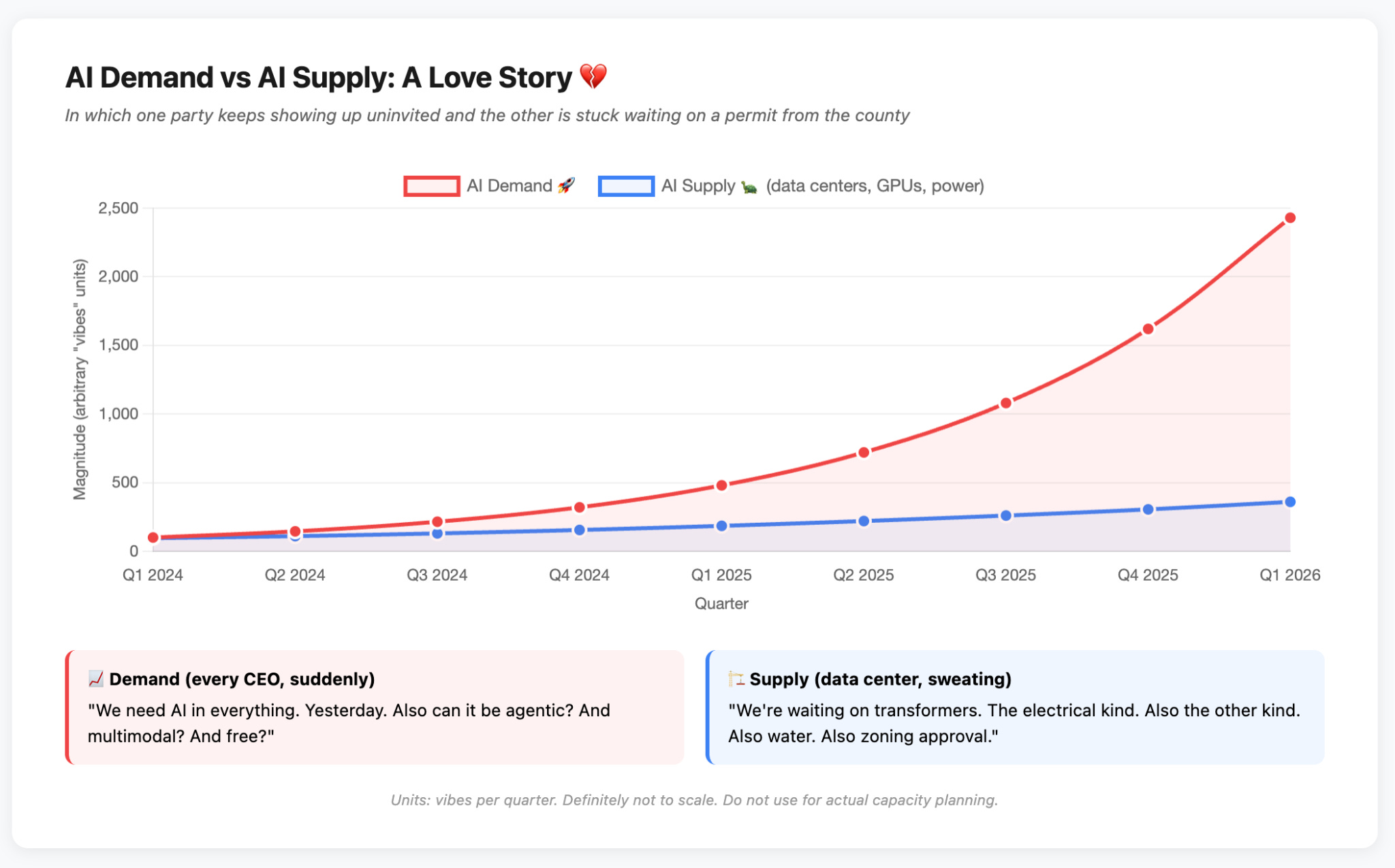
What this means in practice is that, while demand is increasing exponentially, supply is barely increasing at a linear rate. In other words the rate at which supply is growing is not increasing. Supply is still being added every week, but that is just not quick enough. This will change in the next two years or so, because the hyperscalers are throwing so much cash at the problem that the throughput will begin to increase dramatically, but two years is a long time during a tech boom.
TL;DR = smol number is 🐌
AI is now a utility for a billion people
My own business and my daily tasks and concerns have changed because of AI. The technology has been an incredible force multiplier for me and my employees. We are doing things we’ve never been able to do or never been able to afford. If you were to switch off all AI services, my business would suffer. It would not fail, but it would profoundly affect our capacity and our productivity.
I am not at all unusual. I’d be surprised if a single person reading this hasn’t had some aspect of their lives substantially altered by AI. These services have gone from curiosities to toys to useful tools to vital components of life in a matter of 36 months. People joke that WiFi is the bottom of Maslow’s hierarchy of needs, but AI is now more like a utility than any other online service. We can do our jobs without Instagram, but take away our AI agents and we are back to square one, doing manual tasks like animals.
TL;DR = we are all addicted so we are fucked, lol
Okay Adam Smith, what now?
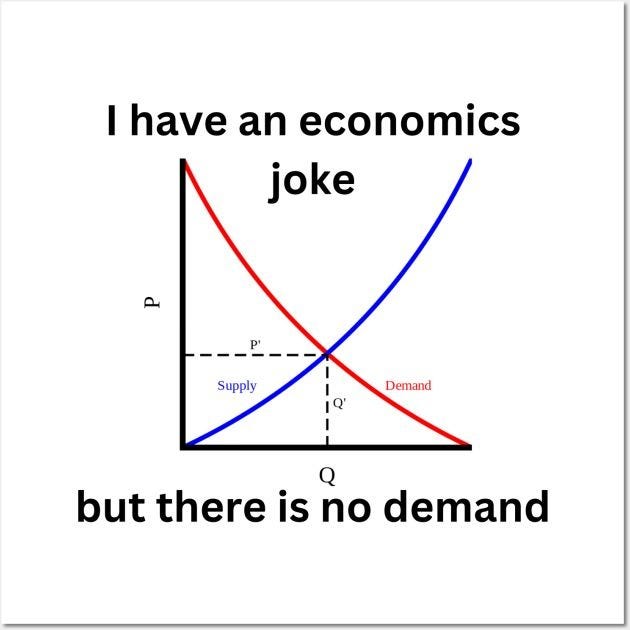
So we have a classic supply and demand situation here. The supply of AI services is increasing relatively slowly compared to the demand for those services. In that case the only practical remedy is to charge more for those services. That means the $30 a month package that has suited you so well for the past year or two may soon be more like $60. The services may choose the shrinkflation approach – reducing usage limits on your existing deal to below what you need – but the result is the same.
This pain will be quadrupled for businesses that have wired everything into AI engines. The sunk cost of that wiring will tend to keep businesses paying eye-watering rates in order to not have to go back to caveman times when accounting had to be done via a web interface 🤮
Even if more virtuous companies like Anthropic go out of their way not to price gouge, desperate customers will approach them and offer to pay a premium for preferential access and capacity. The most efficient way to resolve mismatches between supply and demand is price. This is so axiomatic as to be baked into our very DNA. So, prices will go up. They must.
The predictable reaction to all of this will be shrieks of outrage from the populace at large. It will look very like extortion, but people will keep paying. The damned tools are too useful to just throw away. Some purists and contrarians will swear off all AI tools, but for most mere mortals it’s going to be yet another rent extracted by the vile tech barons.
This crunch won’t last for very long. By 2030 or 2031 so much capacity will be coming online every week that a glut is more likely than a shortage. In the meantime, though, AI adoption will definitely slow. The companies currently still in wait-and-see mode will pat themselves on the back for not adopting too early, and will revel in the schadenfreude of watching their hated rivals snivelling about AI costs in their quarterly earnings. I’m sure we are all very sorry for their terrible losses.
Spare a thought as well for the shareholders of the biggest AI companies. Incinerating a trillion dollars of cash in less than five years is guaranteed to destroy some value. The bet is that said loss will be outweighed by the gains of, for example, forming their own world governments and reintroducing slavery (on a class rather than race basis, of course – this isn’t 1860!)
Whatever happens, it will be fun to watch. And of course I may be totally wrong and all five of you readers can return to this magnum opus to mock me roundly. To that I say, y tu mamá también 😤
P.S. I asked Claude to make me a lighthearted supply and demand curve to illustrate my point and, shame, it tried so hard, poor dear.
Anthropic has always been the most visibly capacity-constrained of the big three and as the pioneers of Claude Code and the first model to make it really useful (Opus 4.5) + the main target of the OpenClaw phenomenon, I think they've been in a particularly difficult and somewhat unique capacity situation over the last few months.
The open-weight, mostly Chinese models make this a more complicated picture. Top Chinese models such as DeepSeek and Kimi have similar capabilities to the top models from the frontier American labs with significantly cheaper API pricing, even when hosted by third parties. Smaller open-weight models, such as the Gemma 4 and Qwen 3.6 series, can provide GPT4o-equivalent performance for many tasks while running on consumer hardware.
We're at the point where a lot of useful AI workloads do not require the latest frontier models, and so I think if OpenAI et al do radically increase their prices, a lot of workflows will shift to lesser-known providers, perhaps even internally managed open-weight models in some cases.
There's a popular folk belief about the frontier labs becoming techno-feudal overlords due to ironclad control over the means of AI inference, but I just don't think their products have enough differentiation for that. People have vibes-based preferences for e.g. Claude vs ChatGPT, but for most tasks these models are pretty much interchangeable, and this will be true for more and more especially non-frontier models as time goes on. Most heavy users I know already ruthlessly switch between monthly subscriptions to the frontier products.
I think we'll see a rise in companies that just provide inference using open-weight models, and can thus set prices without needing to consider the costs of their own model training. The frontier labs have no moats, the second-tier labs are months, not years, behind in capability, and we're doing more with smaller models. IMO it's just a matter of time before AI inference becomes a commodity.
Yes I agree with you in that these companies are going to follow the same path as pretty much every other technology for the last 20 years.
Provide a loss leader, then enshittify.
I’m curious if you would be willing to share what your business is?