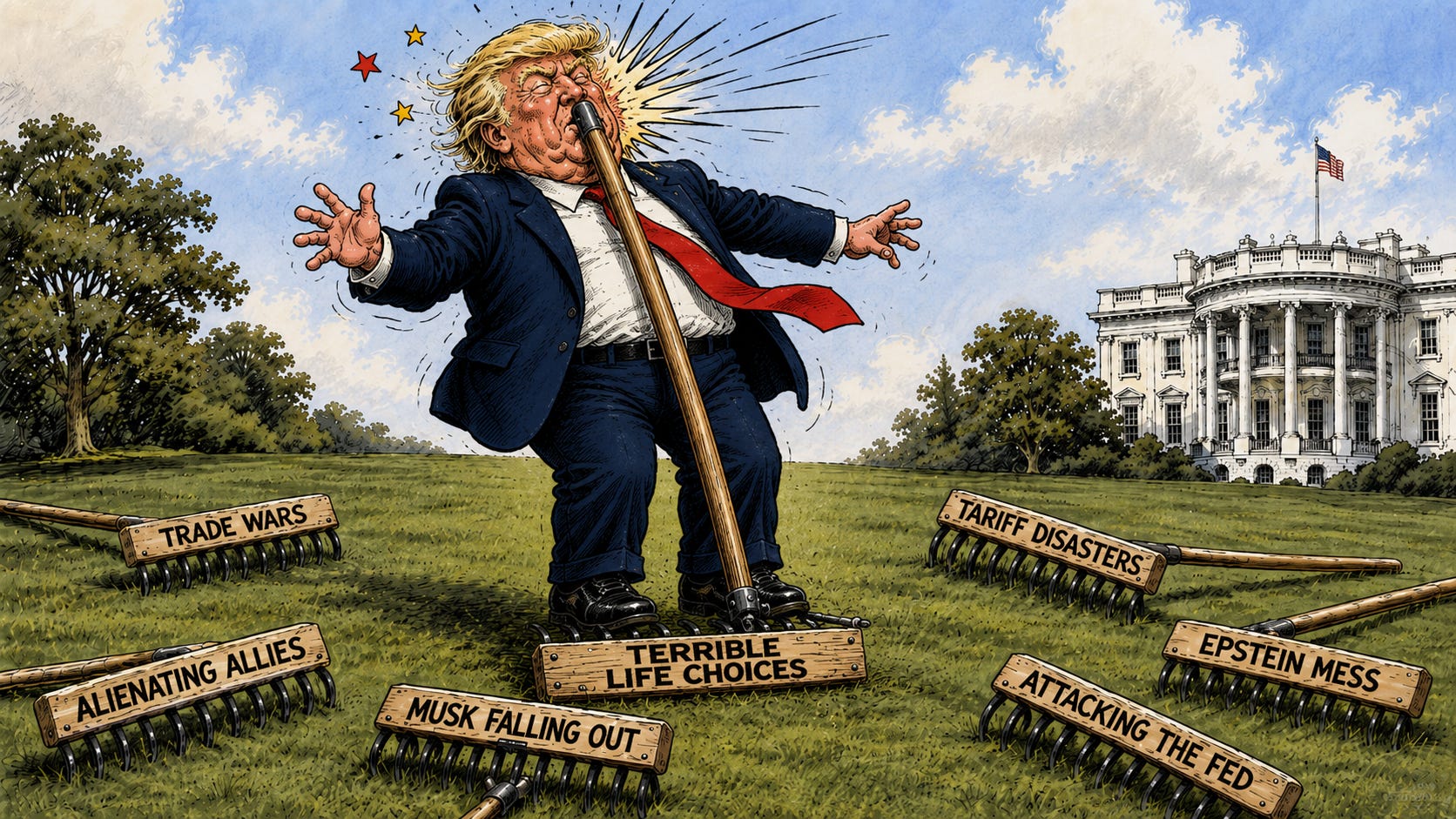
Historical irony is arguably the rarest form of that elusive concept. The sweep of history rarely produces neat collisions of intent and outcome, or ties up folly in a pleasing package. But the second presidency of Donald John Trump is replete with historical ironies of the most delicious variety.
Before we embark on our tour of vanity and hubris writ global, let’s define what we mean by historical irony. In essence it’s when the outcome of an historical event is in direct contradiction to the intentions of the people behind that event. The purest form of historical irony comes from powerful individuals or groups whose selfish or callous actions result in their downfall.
Perhaps the most famous example is the Nobel Peace Prize, established by the man who invented dynamite and who feared his legacy would be that of a merchant of death. Said prize will feature in our tale a little later.
Mr Trump is a kind of idiot savant when it comes to historical irony. To fully appreciate this talent, it’s useful to start with a selection of his most infamously capricious and cruel actions:
He has (repeatedly) refused to aid Ukraine in their defensive war against the Russian juggernaut
He has bullied other NATO members into spending far more money on defence
He has cosied up to Vladimir Putin, one of the most wicked autocrats of the century, at the expense of America’s long-term allies
He has attacked the independence of the Federal Reserve and rammed through his own candidate for chairman, Kevin Warsh, for the express purpose of lowering interest rates
He has sought to bully Congress into passing a particularly odious voter-suppression bill called the Save America Act
He has started a war with Iran, against the counsel of his military and intelligence advisors
All of these actions have resulted in chains of interrelated ironies, as each new thoughtless blunder collides with the wreckage of a previous folly.
Let’s start with Trump’s churlish refusal to aid Ukraine against Russia. His reason for refusing this aid is neither complex nor geopolitical. He is simply still angry about the leaked phone call with Volodymyr Zelenskyy that resulted in his first impeachment.
Without aid from the USA, Ukraine was forced to make do with the few resources it had available. The resulting innovations have fundamentally transformed modern warfare, as Ukraine fields fleets of deadly smart-drones, undetectable by radar and able to strike at Russia’s heartland. As a result the Russian army is now losing soldiers faster than it can replace them, with a total casualty count of more than 1.2 million.
This new style of warfare has not gone unnoticed. Countries around the world are already reshaping their own armed forces accordingly. One of those nations, long a global pariah and starved of resources by relentless sanctions, jumped at the opportunity offered by this kind of asymmetrical warfare. As a result the Iranian Republican Guard Corps (IRGC) has spent half a decade developing one of the most advanced drone forces in the world.
Which in turn is why, when Mr Trump began his ill-fated adventure against Iran in February, his military commanders informed him that they could not station their carrier battle groups inside the Persian Gulf – as they had done for half a dozen other wars in the region.
Despite America’s unparalleled dominance in conventional military hardware, its forces have no sufficiently reliable defence against swarms of cheap drones. Shooting down drones that cost $50,000 with missiles that cost (literally) one hundred times more is not a sustainable strategy. As a result the US military has been forced to rely on (even more) scarce and expensive long-range munitions when attacking Iran.
Despite this reality, the Trump administration failed to anticipate the capacity of the IRGC to effectively close the Strait of Hormuz using a handful of mines, drones and cheap short-range missiles. All the might of two full carrier groups, tens of thousands of troops and the world’s largest military budget has been unable to change this new status quo.
To add insult to injury, Trump’s much-maligned NATO allies have also noticed that warfare has changed, and have learnt from Mr Trump’s clownish escapades in the Gulf. As a result, while many European nations are vastly increasing their military spending (Germany is spending €800 billion over the next five years), much of it will not be lavished on the kind of expensive conventional gear made in the USA.
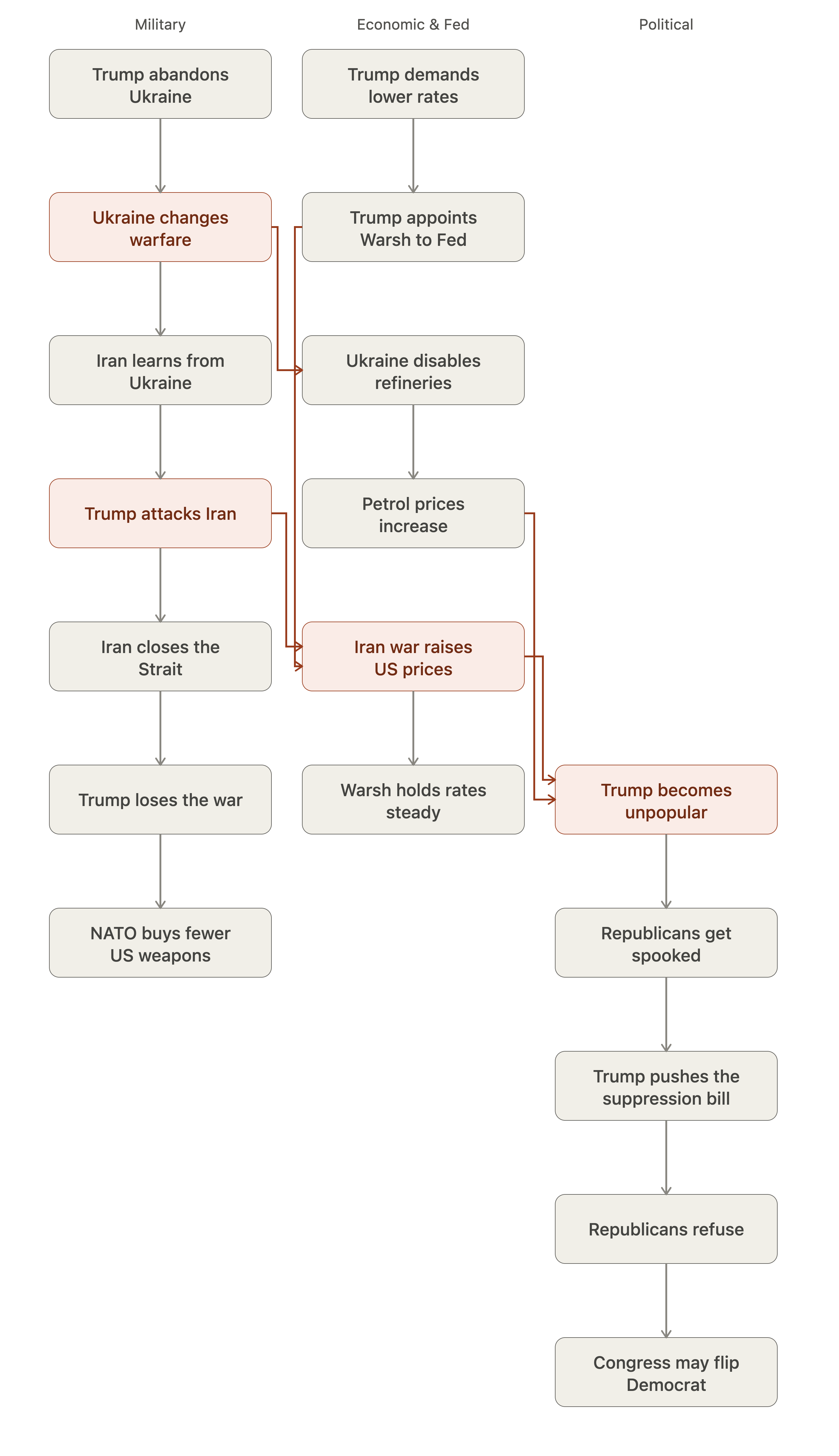
So let’s review the chain of rich ironies so far: Trump abandons Ukraine → Ukraine evolves warfare → Iran learns from Ukraine → Trump attacks Iran → Iran closes the Strait of Hormuz → Trump loses war → NATO decides to buy fewer weapons from the USA. (See the handy diagram below1 for the more visually inclined.)
At every stage of this chain of events Mr Trump’s own actions are either a large contributor to, or the direct cause of, his failure to achieve his aims. For example, when he bullied NATO members into doubling their defence budgets, he assumed this spending would go to American firms. Instead, European nations have bolstered their own domestic arms manufacturers. This led to the very amusing spectacle of Marco Rubio, Trump’s Secretary of State, complaining about Europeans buying fewer American arms.
But our chain is far from complete. As the US economy has struggled with inflation and a cost of living crisis, Mr Trump has been obsessed with bringing down interest rates as a way to juice the economy. He has gone to absurd lengths to achieve this, including turning his Department of Justice against members of the Federal Reserve’s open market committee, which sets interest rates.
With the appointment of Kevin Warsh, his hand-picked candidate, as chairman of the Fed, Mr Trump was expecting to finally get his way on interest rates. Instead, because high petrol prices caused by the Iran war are driving up inflation, Warsh has been forced to hold rates steady and is likely to raise them at least once before the end of the year.
And so our chain has another set of links: Trump demands lower rates → Trump appoints Warsh → Iran war increases prices in the USA → Warsh holds rates steady.
Mr Trump campaigned explicitly on the slogan “no new wars”. Breaking that promise, along with the resulting high petrol prices, has made both the war with Iran and the president himself extremely unpopular. Mr Trump rushed to sign a shoddy MOU with Iran in a desperate bid to bring down those prices and save his party’s chances in the midterm elections.
But in a particularly sweet twist of the ironic knife, Ukraine has since destroyed or disabled between a third and half of all Russia’s oil refining capacity. This has caused havoc in Russia and forced it to halt the export of diesel just when the prices of fuel were beginning to decline in the USA.
If the petrol price remains high, then the chances of the Republicans holding both House and Senate falls to zero, and the chances of losing both becomes increasingly likely. Republicans are now so spooked they have begun to plan for the possibility of a Democrat majority in both houses.
One important side effect of this is that the Republican-controlled Senate is unwilling to pass the Save America Act. The bill is currently held up by a filibuster and thus requires 60 votes to pass. Given that the Republicans only have 53 seats in the Senate, they cannot force it through unless they change the rules of the filibuster – but if they do so, the Democrats will be unimpeded by the same rule if they take power. And so the more traditionalist senators are simply refusing to do Trump’s bidding.
And thus another link in our ironic saga: Trump attacks Iran → Trump becomes unpopular → Republicans get spooked → Trump demands they pass his voter-suppression bill → Republicans refuse → House and Senate become more likely to flip in November. This is particularly amusing because one of the reasons Trump is obsessed with passing this bill is the fact that he’s in danger of losing power come November.
It’s safe to say that Mr Trump’s most enduring obsession, winning the Nobel Peace Prize, is now firmly out of reach. This is the crowning irony of Mr Trump’s entire political career. The only reason he wants said prize is because his arch-nemesis, Barack Obama, received one – and Obama received his, in part, because of the nuclear deal he negotiated with Iran. Cue Alanis Morisette.
There are several more chains of irony here, but I won’t labour the point. Suffice to say that Mr Trump has a truly extraordinary talent for tripping over his own feet and then threatening to sue his shoes for the insult. Were the consequences of his buffoonish antics not so serious, his presidency would be pure comedy. And, truly, it couldn’t have happened to a nicer guy.
The Flow Chart of Folly